


Evolutionary Biology
Cooperation is present in all life forms, but it is precisely in human society, where it reaches the maximum expression. Since the origins of civilization, humans realized the impossibility of surviving in isolation and without the others help. Step by step, specialization of labor generated new ideas and concepts and contributed to the improvement of manual skills, which benefits were subsequently reverted to group level. This dynamic together with the development of language enabled to reach higher forms of collective organization. Throughout history, humans have created rules, doctrines and laws to regulate the functioning of society. Gradually (after many, many years of evolution), this process led to our complex society basically based on sophisticated models of nations and supranational institutions. Nowadays, high technological specialization and advances in science would not have been possible without human cooperation. In a world increasingly developed in all areas, and in which the interaction networks between individuals are becoming more complex and evident, different hypotheses emerge to explain the foundations of human cooperation on a large scale and the true motivations that underlie this mechanism. From a social perspective, the behavior of individuals in certain circumstances is a mystery yet to reveal.
 Thus, it is not surprising that the understanding of cooperative phenomena in natural and social systems has been the subject of intense research during decades. This is because the observed survival of cooperation among unrelated individuals in social communities is not expected when selfish actions provide a higher benefit. The problem can be addressed from many different perspectives and is far from being solved. In our group, we use Evolutionary Game Theory to study how cooperation survives. We have addressed this problem taking into account the complex topological patterns of the networks of contacts that define the interactions of the gamers. Our results have shown that the paths towards cooperation (or defection) strongly depend on the underlying structure and explained why cooperation in SF networks is favored. Although the latter results explain how cooperation survives in heterogeneous structures, they don’t provide insights into a more fundamental problem: if SF networks are better suited for cooperation, where did they come from? To answer this question, we have been working on the development of models for growing networks where the grow process is fed back with the results of the game being played while the network is growing. Current interests of our group in this line of research include the study of new evolutionary graph problems, the introduction of theoretical techniques that allow to study the problem as a phase transition, the coevolution of evolutionary dynamics and network topology and the emergence of cooperation when different dilemmas are at work.
Heterogeneous Networks do no promote cooperation among humans playing a PD game
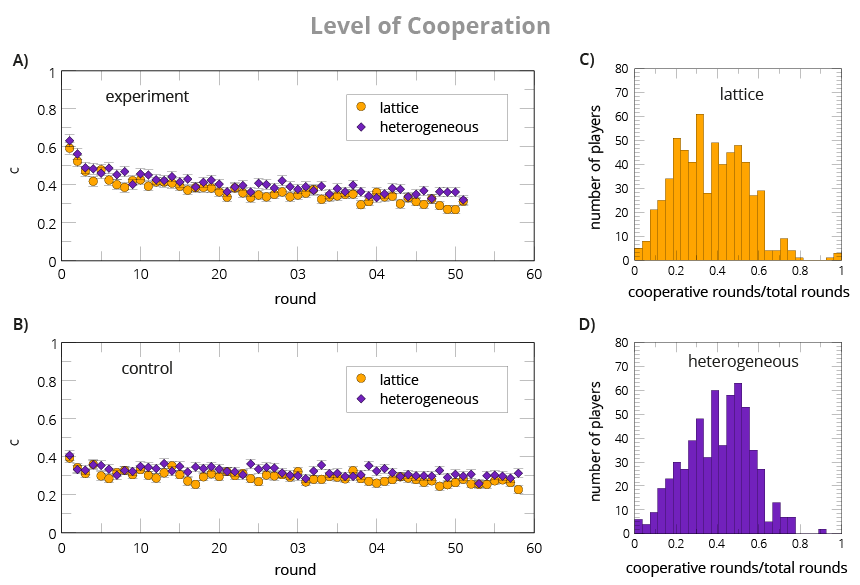 It is not fully understood yet why we cooperate with strangers on a daily basis. In an increasingly global world, where interaction networks and relationships between individuals are becoming more complex, different hypotheses have been put forward to explain the foundations of human cooperation on a large scale and to account for the true motivations that are behind this phenomenon. In this context, population structure has been suggested to foster cooperation in social dilemmas, but theoretical studies of this mechanism have yielded contradictory results so far, and the issue lacks a proper experimental test in large enough systems. We have performed the largest experiments to date with humans playing a spatial Prisoner’s Dilemma on a lattice and on a scale-free network (1229 subjects). We observed that the level of cooperation reached in both networks is the same, comparable to that of smaller networks or unstructured populations. We have also found that subjects respond to the cooperation they observe in a reciprocal manner, being more likely to cooperate if in the previous round many of their neighbors and themselves did so. This implies that humans do not consider neighbors’ payoffs when making their decisions in this dilemma, but only their actions. Our results, that are in agreement with recent theoretical predictions based on this behavioral rule, suggest that population structure has little relevance as a cooperation-promoter or inhibitor among humans.
For more information, visit Nectunt: Webpage on Social Dilemmas and Human Behavior
