Highlights

[Physics of Life Reviews 51:283-293 (2024)] LLMs and generative agent-based models for complex systems research

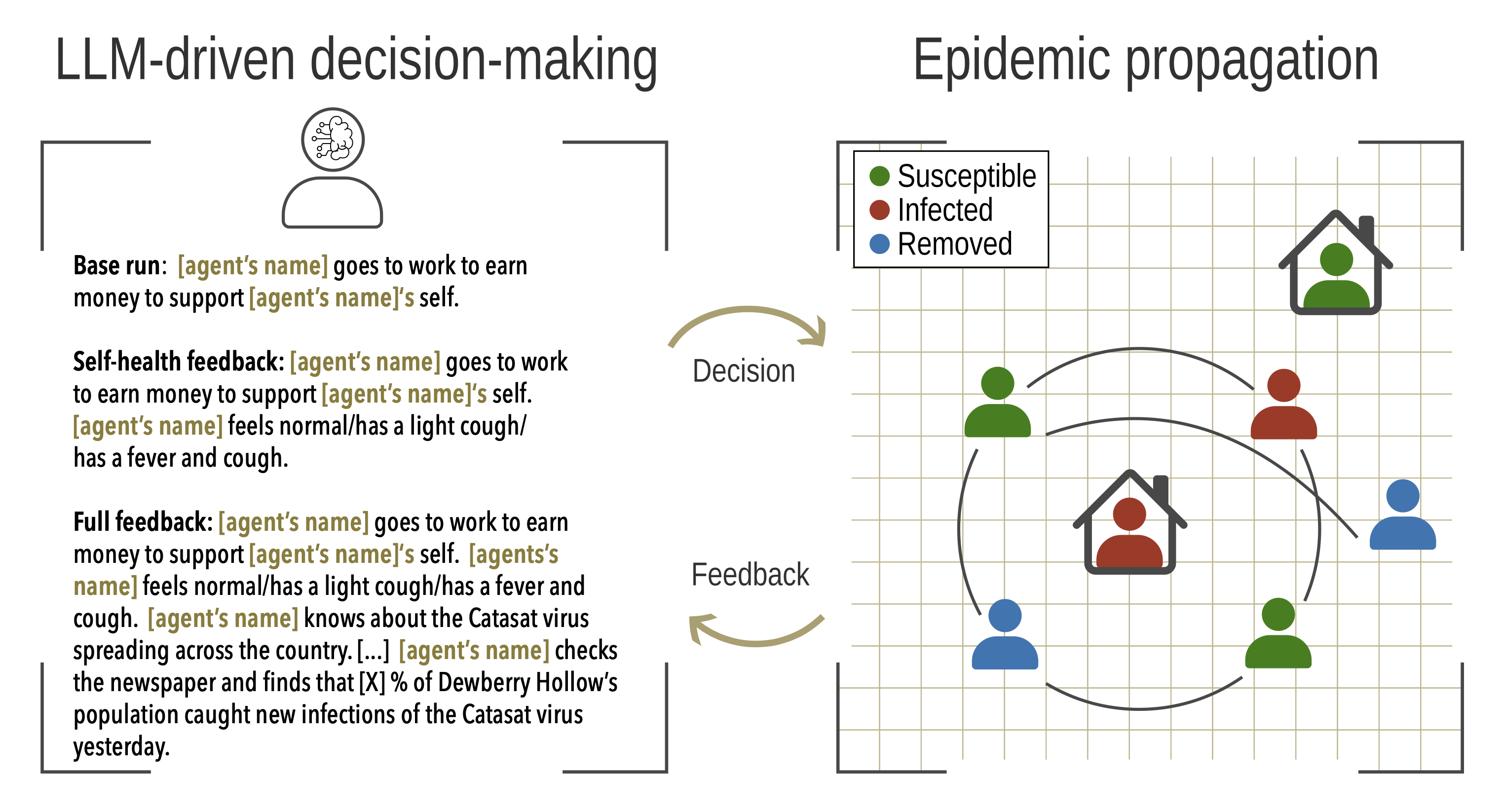
Summary: The advent of Large Language Models (LLMs) offers to transform research across natural and social sciences, offering new paradigms for understanding complex systems. In particular, Generative Agent-Based Models (GABMs), which integrate LLMs to simulate human behavior, have attracted increasing public attention due to their potential to model complex interactions in a wide range of artificial environments. This paper briefly reviews the disruptive role LLMs are playing in fields such as network science, evolutionary game theory, social dynamics, and epidemic modeling. We assess recent advancements, including the use of LLMs for predicting social behavior, enhancing cooperation in game theory, and modeling disease propagation. The findings demonstrate that LLMs can reproduce human-like behaviors, such as fairness, cooperation, and social norm adherence, while also introducing unique advantages such as cost efficiency, scalability, and ethical simplification. However, the results reveal inconsistencies in their behavior tied to prompt sensitivity, hallucinations and even the model characteristics, pointing to challenges in controlling these AI-driven agents. Despite their potential, the effective integration of LLMs into decision-making processes —whether in government, societal, or individual contexts— requires addressing biases, prompt design challenges, and understanding the dynamics of human-machine interactions. Future research must refine these models, standardize methodologies, and explore the emergence of new cooperative behaviors as LLMs increasingly interact with humans and each other, potentially transforming how decisions are made across various systems.


Y. Lu, A. Aleta, C. Du, L. Shi, and Y. Moreno, “LLMs and generative agent-based models for complex systems research”, Physics of Life Reviews 51, 283-293 (2024).


[Nature Reviews Physics 6: 468–482 (2024)] Contagion dynamics on higher-order networks

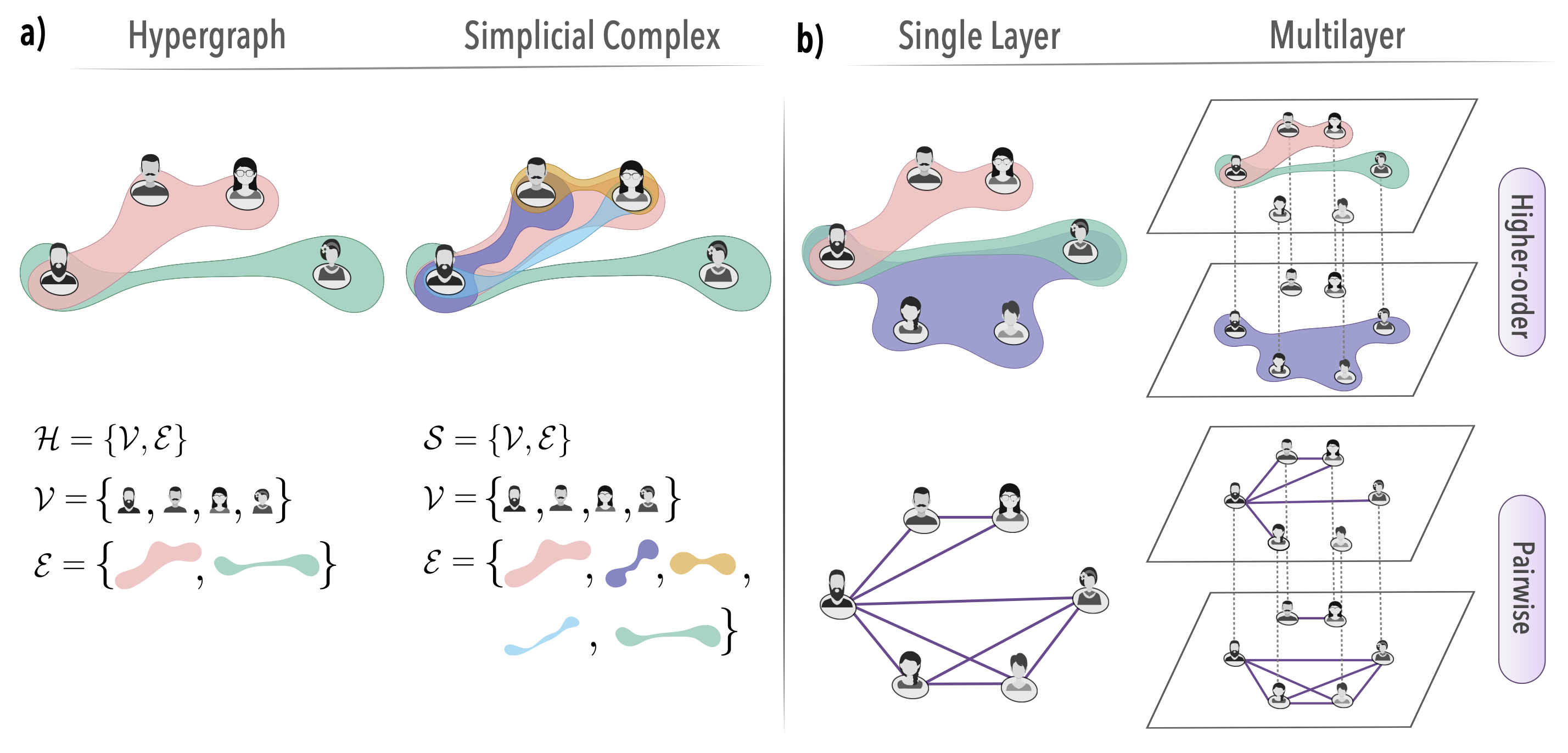
Summary: A paramount research challenge in network and complex systems science is to understand the dissemination of diseases, information and behaviour. The COVID-19 pandemic and the proliferation of misinformation are examples that highlight the importance of these dynamic processes. In recent years, it has become clear that studies of higher-order networks may unlock new avenues for investigating such processes. Despite being in its early stages, the examination of social contagion in higher-order networks has witnessed a surge of research and concepts, revealing different functional forms for the spreading dynamics and offering novel insights. This Review presents a focused overview of this body of literature and proposes a unified formalism that covers most of these forms. The goal is to underscore the similarities and distinctions among various models to motivate further research on the general and universal properties of such models. We also highlight that although the path for additional theoretical exploration appears clear, the empirical validation of these models through data or experiments remains scant, with an unsettled roadmap as of today. We therefore conclude with some perspectives aimed at providing possible research directions that could contribute to a better understanding of this class of dynamical processes, both from a theoretical and a data-oriented point of view.


G. F. de Arruda, A. Aleta, Y. Moreno, “Contagion dynamics on higher-order networks”, Nature Reviews Physics 6, 468–482 (2024).

[Nature Human Behaviour 4, 964–971 (2020)] Modeling the impact of testing, contact tracing and household quarantine on second waves of COVID-19

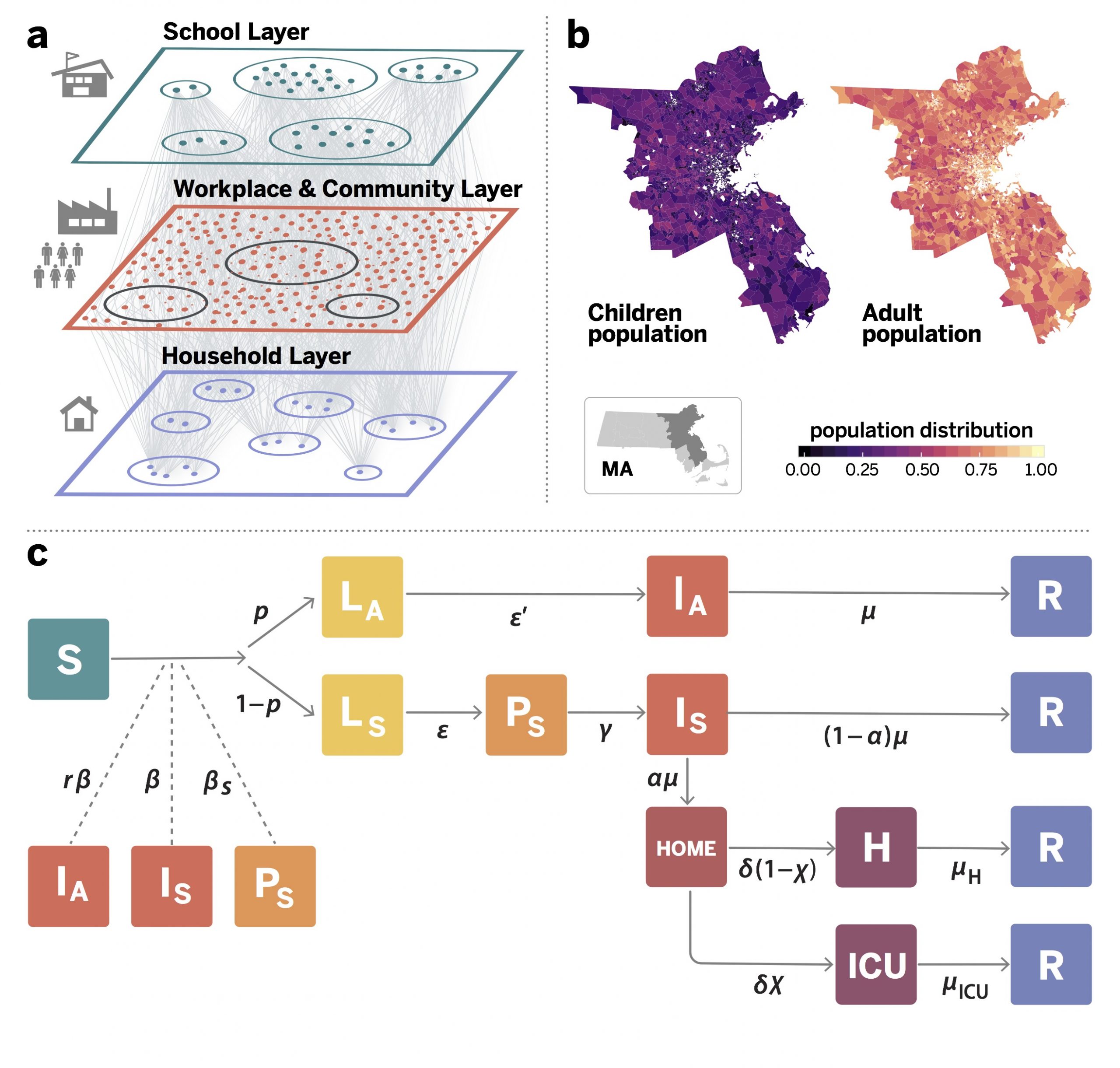
Summary: While severe social-distancing measures have proven effective in slowing the coronavirus disease 2019 (COVID-19) pandemic, second-wave scenarios are likely to emerge as restrictions are lifted. Here we integrate anonymized, geolocalized mobility data with census and demographic data to build a detailed agent-based model of severe acute respiratory syndrome coronavirus 2 (SARS-CoV-2) transmission in the Boston metropolitan area. We find that a period of strict social distancing followed by a robust level of testing, contact-tracing, and household quarantine could keep the disease within the capacity of the healthcare system while enabling the reopening of economic activities. Our results show that a response system based on enhanced testing and contact tracing can have a major role in relaxing social-distancing interventions in the absence of herd immunity against SARS-CoV-2.


Alberto Aleta, David Martin-Corral, Ana Pastore y Piontti, Marco Ajelli, Maria Litvinova, Matteo Chinazzi, Natalie E. Dean, M. Elizabeth Halloran, Ira M. Longini Jr., Stefano Merler, Alex Pentland, Alessandro Vespignani, Esteban Moro, and Yamir Moreno, “Modeling the impact of testing, contact tracing and household quarantine on second waves of COVID-19”, Nature Human Behaviour 4, 964–971 (2020).